
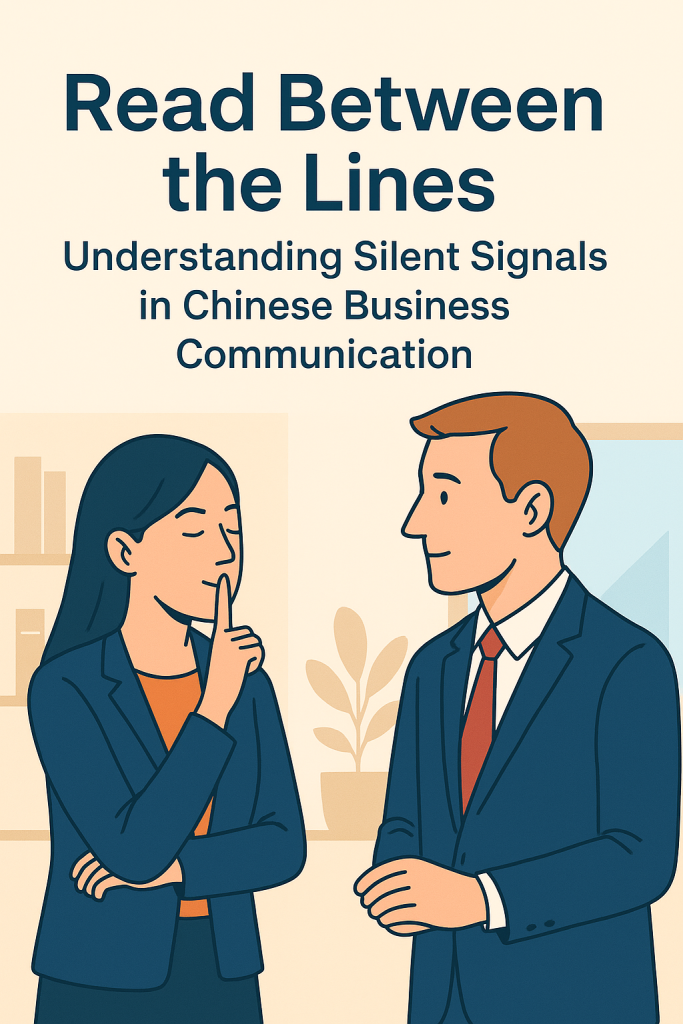
Read Between the Lines: Understanding Silent Signals in Chinese Business Communication
Overview
In many Western business cultures, directness and clarity are prized. In China, however, indirect language, silence, and polite ambiguity are often used to preserve relationships and protect face (mianzi). If you take things at face value, you may miss the real message. This guide helps foreigners decode the subtleties and avoid common cross-cultural pitfalls.
1. Why Chinese People Avoid Saying “No” Directly
Direct refusal can embarrass the other person and damage relationships. To preserve harmony, Chinese professionals prefer polite, indirect alternatives that allow both sides to keep face. Typical goals are:
- Avoid public embarrassment
- Give the other side a “way out”
- Maintain long-term cooperation
- Allow time for internal consultation
2. What Silence Usually Signals
Silence is an important signal in Chinese communication. Common meanings include:
- Need to consult internally: The person cannot decide alone.
- Polite refusal: They prefer not to say “no” bluntly.
- Protection of face: Avoiding words that might offend or embarrass.
- Uncomfortable with the topic: They may change subject or pause.
3. A Short “Chinese Subtext” Dictionary
These polite phrases often mean something different than their literal translation:
| Chinese phrase | What it sounds like | What it often means |
|---|---|---|
| “We will consider it” | Maybe | Probably a soft No |
| “It may be a little difficult” | Hesitation | No / not feasible |
| “Let’s talk later” | Not now | Low priority / likely No |
| “We need time” | Delay | Decision requires approval |
| Smiling + silence | Friendly | Polite refusal or face-saving |
4. Three Common Foreigners’ Mistakes
- Interpreting smiles as agreement. Smiles often protect face, not signal consent.
- Pressing for immediate clarity. Demanding a yes/no can embarrass people and stall relations.
- Assuming vague answers equal a green light. Phrases like “we’ll see” usually mean caution or refusal.
5. Practical Strategies to Avoid Misunderstanding
- Listen for tone and pauses. Hesitation often reveals hesitation in commitment.
- Watch body language. Eye contact, posture and micro-expressions matter.
- Ask open, non-confrontational questions. Example: “What challenges do you see?”
- Offer options. People can accept a softer alternative rather than reject directly.
- Follow up in writing. A polite email summarizing next steps gives space and clarity.
- Build guanxi first. The more trust you have, the more direct and clear communication will become.
6. Example: A Typical Meeting Misread
Foreign manager: “Can you finish this by Friday?”
Chinese partner: “It might be difficult, but we’ll try our best.”
The foreign manager takes it as a tentative yes and sets expectations. The Chinese partner actually means no and is avoiding direct refusal to preserve harmony. Result: missed deadline and frustration. Better approach: ask about specific constraints, offer alternatives, and confirm a realistic ETA later by message.
Conclusion
In China, silence and polite ambiguity are part of the communication toolkit. They protect relationships and keep cooperation possible. For foreigners, learning to read these signals — and responding with patience, options, and follow-up — transforms frustrating misunderstandings into smooth collaboration.