
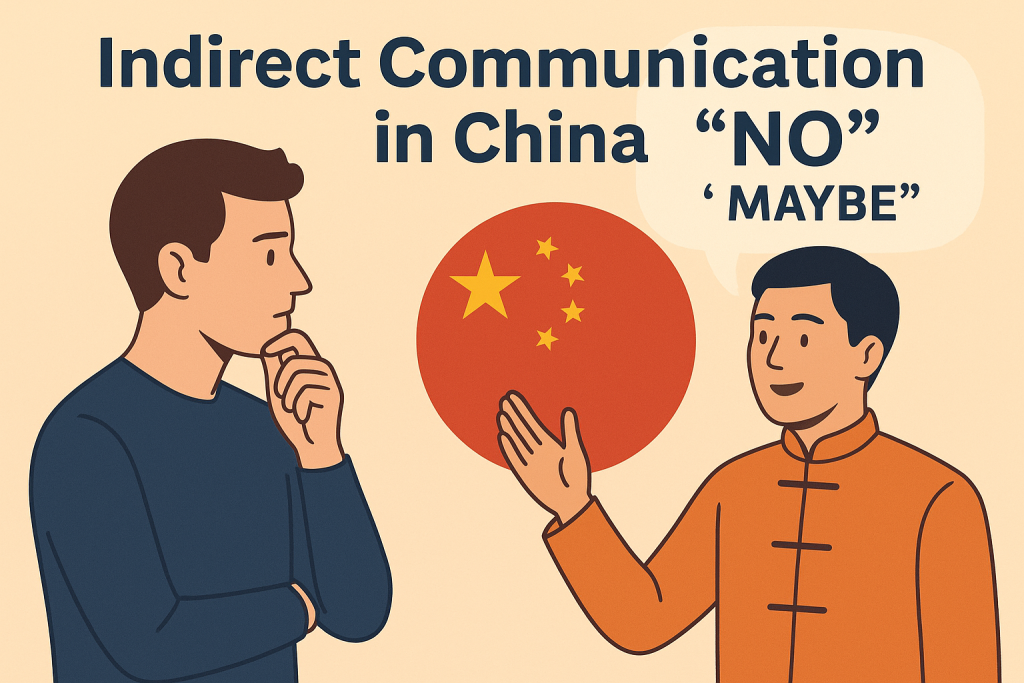
Indirect Communication in China: Why “No” Rarely Means No
For many Western cultures, being direct means being honest.
But in China, direct communication can be seen as rude, confrontational,
or even disrespectful. Understanding the Chinese indirect communication style
is essential for avoiding misunderstandings in business and daily life.
1. Why Chinese Communication Is Indirect
Chinese communication is shaped by traditional cultural values:
- Protecting “Face” (Mianzi) – Avoiding embarrassment for both sides.
- Social Harmony – Reducing conflict is more important than clarity.
- Respect – Softening words shows politeness.
- High-context Culture – Meaning is understood through tone and context, not exact words.
2. What “No” Sounds Like in China
Chinese people rarely say “No” directly. Instead, they might say:
- “It may be difficult.”
- “We will think about it.”
- “Let’s discuss later.”
- “Maybe another time.”
- “We’ll try our best.”
- Silence or a change of topic.
To a foreigner, these sound like “Maybe.”
To a Chinese person, these mean “No, but politely.”
3. Why Foreigners Misinterpret Chinese Indirectness
Western communication prefers:
- Clarity
- Direct expression
- Efficiency
Chinese communication prefers:
- Harmony
- Politeness
- Maintaining relationships
It’s not dishonesty — it’s cultural logic.
4. How to Interpret Indirect Responses Correctly
- “It’s a bit difficult.” → Usually means **No**.
- “We will think about it.” → Means **Probably No**.
- “Maybe later.” → Means **Not now / not interested**.
- Silence → Means **No**.
- Changing the subject → Means **Not comfortable discussing**.
5. Why Indirect Speech Feels “Vague” to Foreigners
Because in China:
- Tone carries meaning.
- Context is crucial.
- Avoiding conflict is valued.
- Emotional intelligence is part of communication.
Directness is not always seen as honesty —
sometimes it is seen as disrespect.
6. How Foreigners Can Communicate Better
- Read tone and hesitation — not just words.
- Avoid forcing direct answers.
- Use gentle questions like “What challenges do you see?”
- Provide options so the other side doesn’t have to reject you.
- Build guanxi first — people become more direct once trust is formed.
7. Real Business Example
Western manager:
“Can you finish this by Friday?”
Chinese colleague:
“It might be difficult, but we will try our best.”
Western interpretation:
“They will try.”
Chinese meaning:
“No, but I don’t want to embarrass you.”
Understanding this prevents frustration on both sides and improves cooperation.
Conclusion
Indirect communication is not a misunderstanding —
it is a cultural strategy to protect relationships and maintain harmony.
By understanding what Chinese people really mean,
you will build stronger trust and more effective communication.